The museum is currently closed. Our hours are Wed - Sat, 10AM - 4PM. General Admission - Only $5!

Homer’s The Odyssey reveals rich descriptions of Bronze Age ships and seafaring 

​-by John S. Sledge

This summer, as people jam theaters and thrill to Christopher Nolan’s blockbuster rendition of “The Odyssey,” book sales of the ancient Greek epic have commensurately skyrocketed. Of the well over 60 English translations currently available, none has sold as briskly or generated as much comment as that by Emily Wilson, a British-American classicist whose 2017 version, the first into English by a woman, Nolan himself has cited as an influence on the film. Regardless of which translation one might choose to read, however, they all tell the same story of a hero’s fraught return home after a long and ruinous war. 

Christopher Nolan’s blockbuster interpretation of Homer’s poem has brought legions of new fans to this timeless epic.

While general readers have long enjoyed The Odyssey for its drama and adventure, historians and archaeologists have noted that among the wonders, heroes, gods, goddesses, and monsters are numerous insights into the daily life of the ancient Greeks. References to clothing, armor, weapons,jewelry, architecture, furniture, foodways, hunting, and customs like the importance of hospitality have all proved helpful to scholars seeking to understand that distant time. But perhaps no aspect of the poem is as striking as its profound grasp of the Greek world’s maritime nature. Indeed, references to ships and seafaring are ubiquitous in the poem. 

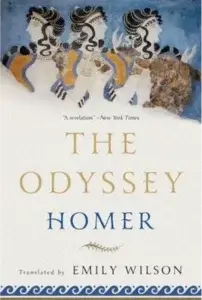
Emily Wilson’s 2017 bestselling translation of the poem renders Homer’s tale in brisk, clear English prose.

Scholars generally agree that The Odyssey was first written down sometime during the 8th century B.C.E. by a gifted poet known simply as Homer, whose name means “hostage.” Before that, the tale existed as an oral tradition dating back a further thousand years to the Bronze Age, when court performers and traveling bards entertained noble audiences with colorful stories replete with mythology and familiar events. Homer’s retention of numerous repetitive descriptive phrases like “rosy-fingered dawn,” “wine-dark sea,” “hollow ships,” and “owl-eyed Athena” are clues to this oral inheritance. Such phrases acted as memory cues or useful fillers that allowed the bard to anticipate or compose his next lines even as he strummed his lyre fireside.  

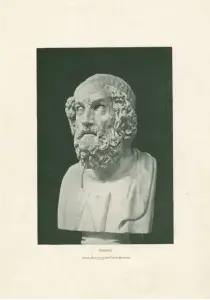
The Greek poet Homer is believed to have first written down The Odyssey sometime during the 8th century B.C.E. He did not create it out of whole cloth but rather worked from a centuries-old oral tradition.

The Odyssey describes its eponymous hero’s 10-year journey after the siege of Troy, likely a real event. Any bard’s audience, and certainly Homer’s, would have been thoroughly familiar with the Mediterranean and Aegean world’s maritime setting and the realities that permeate the tale. Numerous small kingdoms like Ithaca (Odysseus’ home island), Pylos, Sparta, and Troy alternately traded and warred with one another along well-established sea routes. Small single-masted ships seating up to 40 rowers regularly plied local waters loaded with stacks of ivory or copper on deck and with amphorae full of wine, olive oil, and honey wedged down between the rowers. The ancient Greeks typically only traveled by daylight, wayfinding between familiar landforms, and beached their vessels at night.  

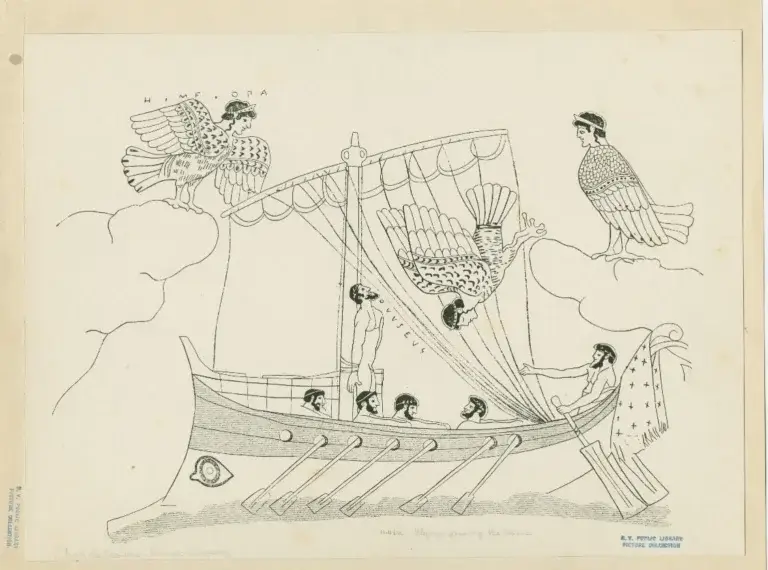
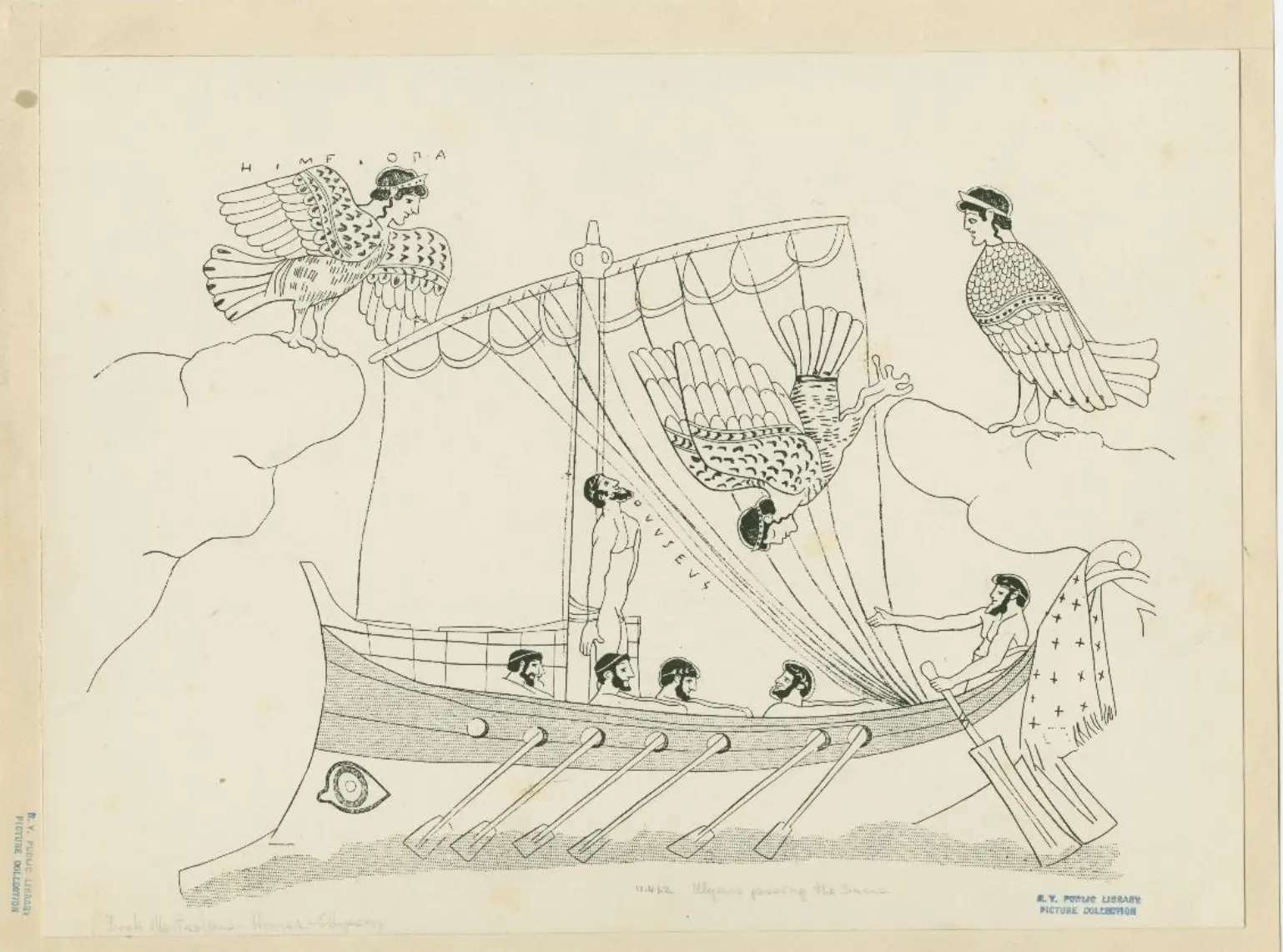
Odysseus enjoys the enchanting song of the sirens but saves his ship from destruction by filling his crew's ears with wax and ordering them to lash him to the mast so that only he can hear. As a result, one of the bird-shaped beings casts herself from her perch in despair. Drawn from a 5th century B.C.E. vase by a late nineteenth-century artist, it accurately depicts a small Bronze Age vessel.

The Odyssey’s frequent, tactile depictions of Bronze Age seafaring help give the poem its ring of authenticity. For example, in Book 2 Odysseus’ son Telemachus determines to seek news of his father from King Nestor at “sandy Pylos.” In preparation, Athena pushes a ship off the beach into the harbor overnight. The following morning Telemachus’ crew loads it with provisions, and they set sail. Quoting from Wilson’s translation, lines 420-29,  

“Athena called a favorable wind, 

pure Zephyr whistling on wine-dark sea. 

Telemachus commanded his companions 

to seize the rigging; so they did, and raised 

 the pine-wood mast inside the rounded block, 

and raised the bright white sails with leather ropes. 

Wind blew the middle sail; the purple wave 

was splashing loudly round the moving keel. 

The goddess rode the waves and smoothed the way.”    

One can only admire Homer’s deft ability to so beautifully impart the quotidian process of setting sail. In only eight lines, Telemachus’ men step (i.e., raise) the mast, hoist the sail, and run before a favorable breeze, complete with color and sound effects. The reader powerfully feels this to be a world of wood, canvas, leather, and brawn, suffused by divine will. 

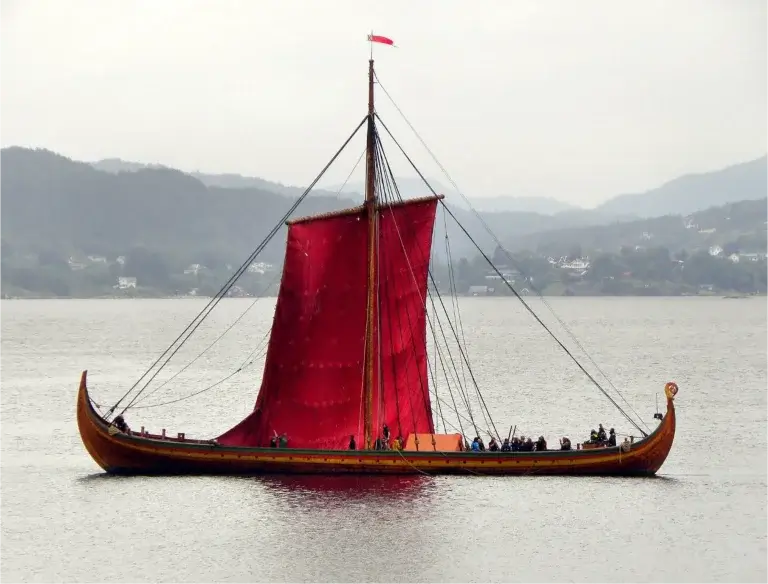
Christopher Nolen used a modern replica of an 11th-century Viking ship, the Draken Harald Hårfagre, for the film. Bronze Age vessels were considerably smaller and less seaworthy.

The particulars of building a Bronze Age ship are related in Book 5, when Zeus orders the goddess Calypso to let Odysseus go after she has held him captive seven years on her enchanted island. She provides the hero with an axe and an adze and leads him into a grove of tall trees. Again, quoting from Wilson, lines 244-61: 

“With his bronze axe he cut down twenty trunks, 

polished them skillfully and planed them straight, 

 Calypso brought a gimlet and he drilled 

through every plank and fitted them together, 

fixing it firm with pegs and fastenings. 

As wide as when a man who knows his trade 

marks out the curving hull to fit a ship, 

so wide Odysseus marked out his raft. 

He notched the side decks to the close-set frame 

and fixed long planks along the ribs to finish. 

He set a mast inside, and joined to it 

A yardarm and a rudder to steer straight. 

He heaped the boat with brush, and caulked the sides 

With wickerwork, to keep the water out. 

Calypso brought him fabric for a sail, 

and he constructed that with equal skill.  

He fastened up the braces, clews and halyards, 

and using levers, launched her on the sea.”  

This passage is justifiably famous among maritime historians for its clarity and economy. Only a culture deeply versed and experienced in building seaworthy boats from scratch could have produced such a poet. 

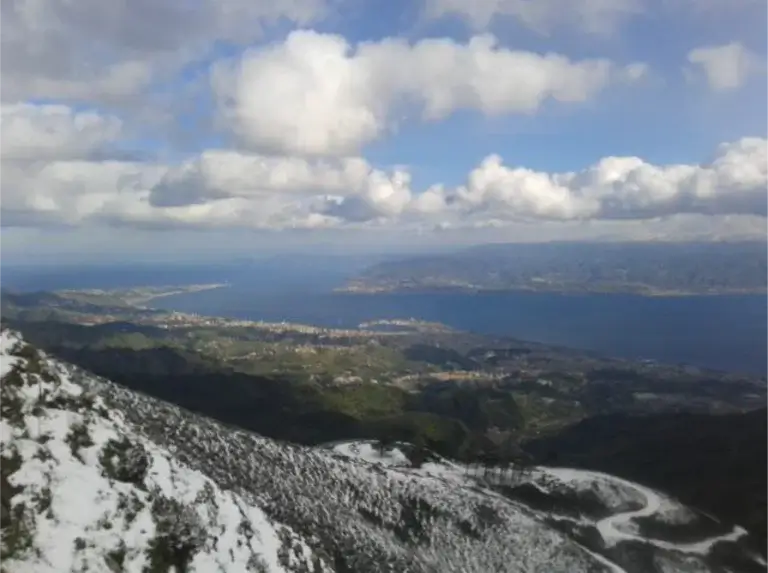
The Strait of Messina, known for powerful currents, may have inspired the Scylla and Charybdis episode in Homer’s poem.

Finally, the perils of Bronze Age travel are nowhere more vividly evoked than in Book 12’s hair-raising description of the passage between Scylla and Charybdis. Odysseus describes his many trials to the Phaeacians. These kindly people rescued him after Poseidon wrecked his craft when he left Calypso’s island. Quoting from Wilson, lines 233-43: 

“So we rowed through the narrow strait in tears. 

On one side, Scylla; on the other, shining 

Charybdis with a dreadful gurgling noise 

Sucked down the water. When she spewed it out, 

she seethed, all churning like a broiling cauldron 

on a huge fire. The froth flew high, to spatter 

the topmost rocks on either side. But when 

she swallowed back the sea, she seemed all stirred 

from inside, and the rock around was roaring 

dreadfully, and the dark-blue sand below was visible.” 

Modern researchers have suggested that this frightening episode could refer to the real perils a fragile Bronze Age vessel would have faced in the Strait of Messina, between Sicily and the toe of the Italian boot, a passage known for dangerous currents. As for the six-headed monster Scylla, perhaps it suggests a memory of aggressive sharks or hostile people who lived nearby. Whatever the real-world inspiration for this passage, Homer movingly evokes the Ithacans’ vulnerability in a seething sea.  

Specialists have long studied Homer for clues and insights about the Bronze Age. Such scholarly investigations aside, the story remains riveting entertainment. It is cause for celebration that Nolan’s film and Wilson’s translation are bringing new generations to these timeless tales.  

John S. Sledge is maritime historian-in-residence at the National Maritime Museum of the Gulf.  

Share the Post: