
This article originally appeared Sea History.
-by John S. Sledge
Jules Verne made it famous. In part II, chapter VIII, of his 1869 novel Twenty Thousand Leagues Under the Sea, Captain Nemo deftly steers the Nautilus towards the northwestern Spanish coast and into the recesses of Vigo Bay. There, an astonished Professor Aronnax observes the “ship’s crew in their diving dresses” probing the wrecks of long-sunken Spanish galleons. The submarine’s electric light illuminates the men as they hoist rotten barels and crates out of the ruined hulks. All around them spill doubloons, glittering jewelry, and ingots—an “inexhaustible fishery of gold and silver.” Thus did Nemo fund his tortured cause.
The “curious episode,” as Nemo called it, that inspired Verne’s treasure hunting fantasy was the Battle of Vigo Bay, an epic clash during the early days of the War of the Spanish Succession (1701–1714). The conflict arose from the disagreement as to who would succeed the childless Spanish sovereign, Charles II. Before he died, Charles designated Philip of Anjou, the grandson of France’s King Louis XIV, as his heir, and Philip subsequently assumed the throne. The arrangement created a European power imbalance and pitted Austria-Hungary, England, and the Dutch Republic in a Grand Alliance against France and Spain. The earliest clashes took place in Italy, where Spain had holdings, but the Alliance quickly added a naval component by targeting the Spanish city of Cádiz, reasoning that if the Alliance could secure an Iberian base and gain Portuguese support, it could project power into the western Mediterranean and threaten the critical French port of Toulon.
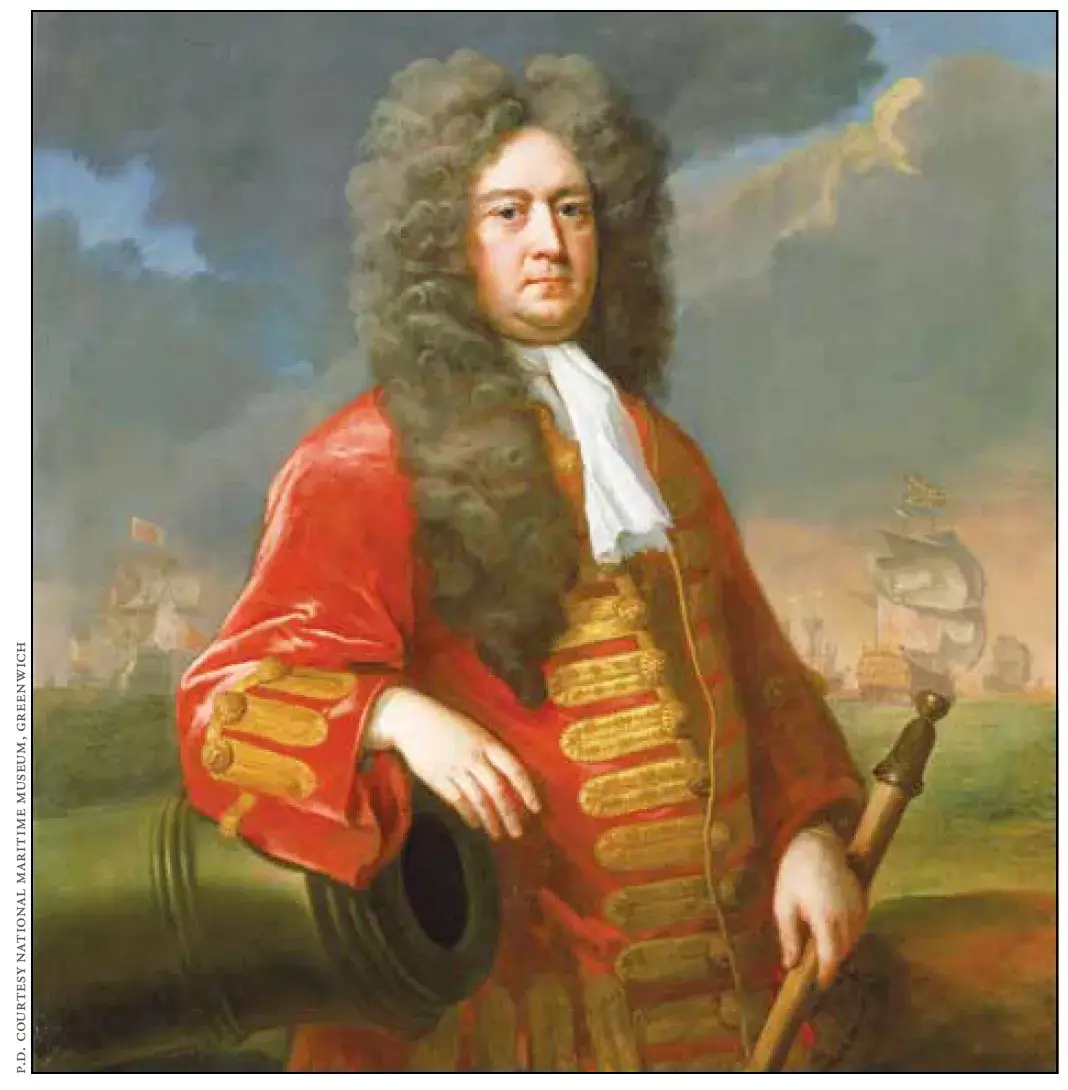
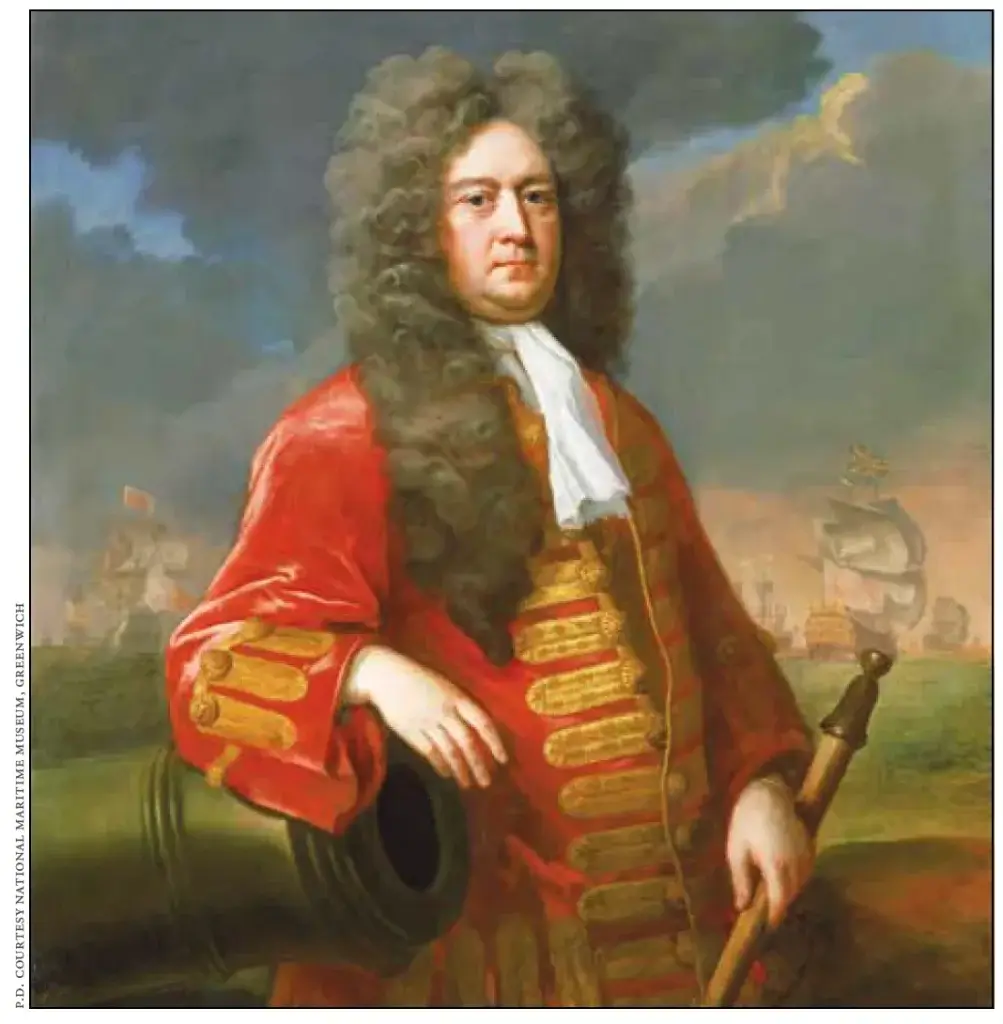
The fleets destined to clash at Vigo Bay began the summer of 1702 on opposite sides of the Atlantic. Securely nestled in Havana’s superb harbor was the Spanish flota—seventeen stately galleons protected by twenty three powerful French ships of the line, along with numerous smaller frigates, schooners, and sloops in support. The galleons had spent the previous months working their way through the Caribbean Sea and the Gulf of Mexico, carrying three years’ worth of New Spain’s wealth in their holds. Besides silver and gold ingots and coins—only twenty percent of the cargo’s total value—they carried pearls, emeralds, amethyst, cotton, wool, tabaco, indigo, Campeche wood, cocoa, vanilla, sugar, pepper, and sarsaparilla. The galleons were under the direct command of Don Manuel de Velasco y Tejada, an experienced officer and member of the religious and military Order of Santiago, while the French warships sailed under François Louis de Rousselet, Conde de Château-Renault, a fearless leader who bore wounds earned chastising the Barbary pirates. Confident in their men and ships, Velasco and Château-Renault led this imposing maritime assemblage into the Florida Straits on 24 July 1702, bound for Cádiz, as yet un-aware that a war was underway on the other side of the Atlantic. Forty-five hundred miles to the east, a combined Anglo-Dutch fleet lay siege to Cádiz, beginning 23 August. Admiral George Rooke, a 52-year-old British officer who had joined the Royal Navy at age twenty-two and had been promoted steadily through the ranks, headed a total of thirty English and twenty Dutch warships, accompanied by dozens of transports and 14,000 troops under the command of James Butler, the 2nd Duke of Ormond. The campaign began badly when dozens of landing craft were swamped by heavy surf, and it continued poorly all summer. The troops overran a small village, got drunk, and proceeded to loot “to the walls” everything from stores to churches and convents. Spanish resistance proved dogged, and the allied soldiers were forced to bivouac in an unhealthy marsh. Wracked by disease and defeat, the army stalled. By 30 September Rooke had given up the contest, reem-barked the men, and sailed for home. He knew nothing, as yet, of the silver fleet.
Thanks to a bevy of fast schooners dispatched by the Spanish crown, Admiral Château-Renault learned of the war and Rooke’s activities while still well out in the Atlantic. An alternate destination was clearly needed—but where? The admiral preferred a French port, but Manuel de Velasco rightly feared that Louis XIV would confiscate the treasure for his own debts and schemes. After much discussion, they settled on Vigo Bay and reached it on 21 October.
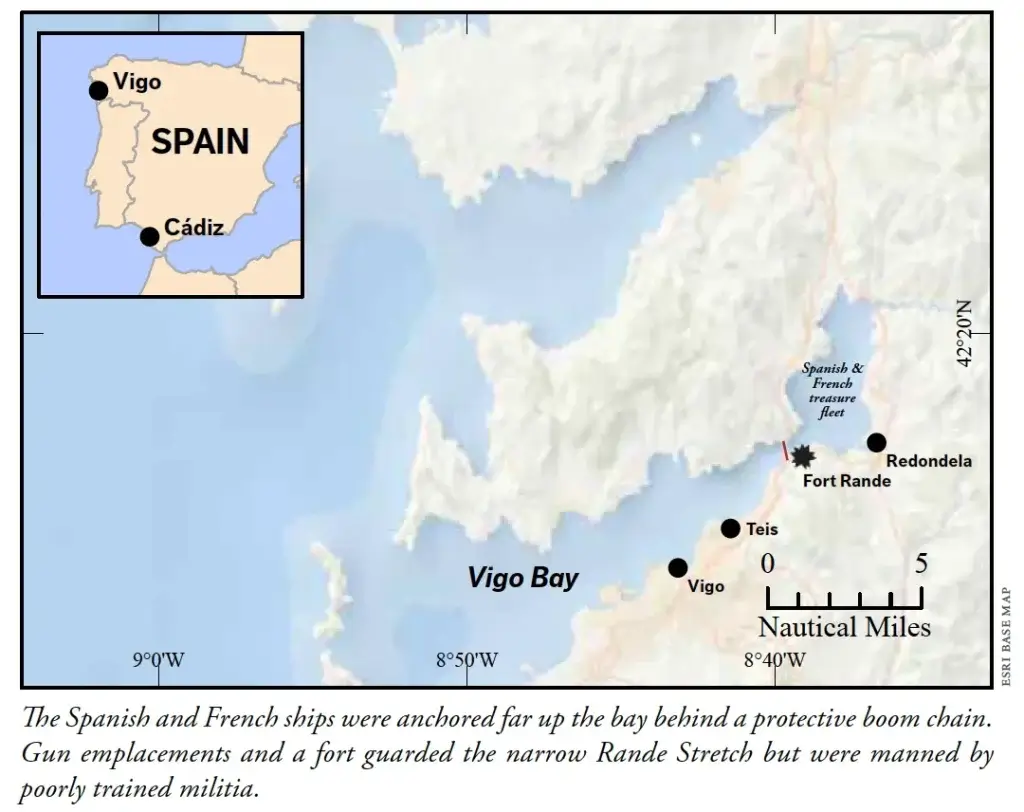
It was seemingly a good choice. More than 500 nautical miles north of Cádiz, Vigo Bay extends twenty-two miles inland on the northwestern Spanish coast just above the Portuguese border, one of a series of such features between there and Cape Finisterre known locally as rías. Its mouth is two miles wide and partially obscured from the open Atlantic by the rocky Cíes Islands, which attain a height of 647 feet. Low hills mantle the bay’s perimeter. The town of Vigo proper, situated on the south shore well inside the entrance, was only a small fishing hamlet in 1702, with a population of fewer than 2,000 souls. A few miles northeast of town the bay narrows down to only 600 yards, a section known as the Rande Stretch, before opening again into pocketed San Simón Bay. The village of Redondela sits on the southeastern shore of this inner harbor.
It was in San Simón that the Franco-Spanish fleet sought refuge. When King Philip learned of its safe arrival, he immediately dispatched bureaucrats and carts to unload the treasure as fast as possible—the silver first. This was a herculean task. Offloading treasure ships required sophisticated administrative and logistical support, none of which was in place at distant Vigo. As many as 1,500 oxcarts, clunky contraptions with solid wooden wheels, converged from all across northern Spain, their drivers promised a ducat a league. San Simón Bay is deeper along its southern and western portions, and it was possible for the big galleons to anchor close to shore, which made unloading manageable despite the lack of wharves, warehouses, or heavy cranes. For weeks men scrambled over the ships, lifting boxes, barrels, crates, and sacks from the holds, stacking them into carts and sending them inland with armed escorts. There was the inevitable graft, as well as some banditry in the countryside, but by and large, the endeavor was a success.
Even as the galleons were unloaded, Château-Renault did all in his power to make the anchorage as secure as possible. The towns of Vigo and Redondela boasted a few gun positions, while the Stretch featured a battery on the north side and Fort Rande on the south. The fort wasn’t much—an old tower and some wooden gun platforms. The French strengthened it with naval guns and men, the latter un-reliable local militia. Most significantly, a giant boom nine feet in circumference fashioned of chains, hawsers, barrels, masts, spars, and outsized junk was drawn across the strait, anchored at either end by a 70-gun ship of the line. Just inside the boom, five ships lay at anchor, their formidable broadsides facing out. Beyond them, more ships of the line were arranged in an open crescent formation to protect the galleons.
Rooke learned of the silver fleet by happy accident on 6 October. One of his captains, Thomas Hardy in command of the Pembroke, had put into the Portuguese port of Lagos to take on fresh water. Dur-ing the two-day layover, the ship’s chaplain stayed with the French consul there, whose “blabbing vanity,” as described by one Eng-lish officer, revealed that a powerful fleet lay safely anchored at nearby Vigo. The chaplain repaired at once to the Pembroke, where he awakened his captain with the intelligence. Hardy made haste to catch Rooke, then breasting foul weather off Cape Finisterre. After he got the news, the admiral ordered a council of war on board his flagship. Given the recent Cádiz debacle, everyone agreed that smashing the Franco-Spanish fleet would be an “honor and advantage” and resolved “that we make the best of our way to the port of Vigo, and insult them immediately with our whole line.”
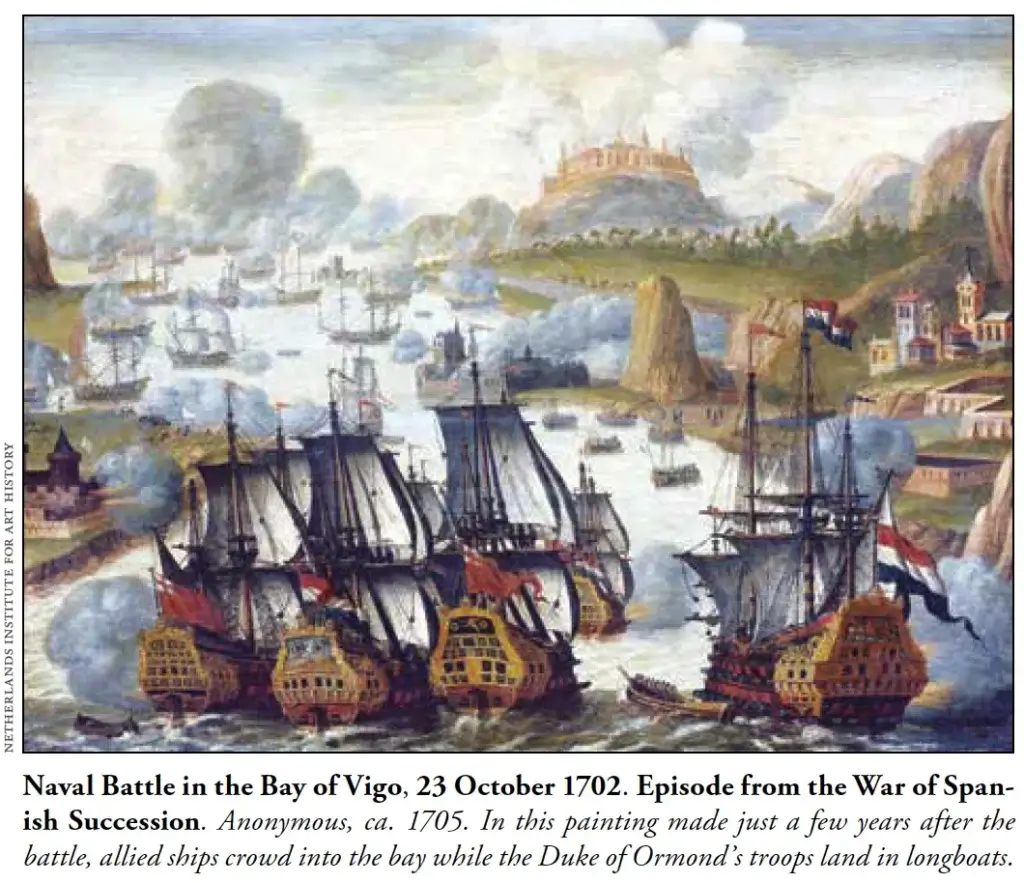
They arrived on 21 October and, partially obscured by fog, glided into the bay “almost to the chain,” according to Rooke. A few desultory shots from Vigo had no effect. It was time for another council of war. Rooke concluded that the entire Anglo-Dutch fleet could not make the attack without “great hazard of being in a huddle” and instead determined to send fifteen British and ten Dutch ships of the line accompanied by fireships straight at the boom. Concurrently, the army, backed by several frigates, would land and assault the fortifications. Given the realities as he found them, Rooke’s battle plan was considered and sagacious. October 23rd dawned gloomy with but little wind. Long boats landed the Duke of Ormand and 2,500 men, including a contingent of the Coldstream Guards, on a sandy beach between Vigo and Fort Rande. They met no opposition. From thence Ormond divided his men into two columns, one to move along the shore and one farther inland over higher ground.
Several thousand Spanish militia appeared but melted away when they saw what Ormond called “the resolution of our forces.” Pressing on, the allies captured the fort’s guns and reached the old tower. The Spaniards held there doggedly, but aggressive work by Ormond’s infantry made it untenable, and more than 350 enemy soldiers surrendered. When the Union Jack fluttered atop the structure, allied sailors cheered lustily.
Meanwhile, the naval assault was underway, led by Sir Thomas Hopsonn on board HMS Torbay, an 80-gun behemoth with massive 32-pounder guns on her lower deck. The Duke of Ormond had a clear view of the ensuing action. “We had no sooner took the platform,” he later wrote, “on which were 38 cannon, but the detached ships, which were in line of battle, began to sail.” Ormond admired Hopsonn’s “undaunted courage” and was awed by the din of battle, “so that for a considerable time the firing of great and small shot on both sides was so terrible that I want words to relate it.”
A fortuitous breeze allowed the Torbay to plow across the boom, but then the wind stilled, stranding the ship among her foes.
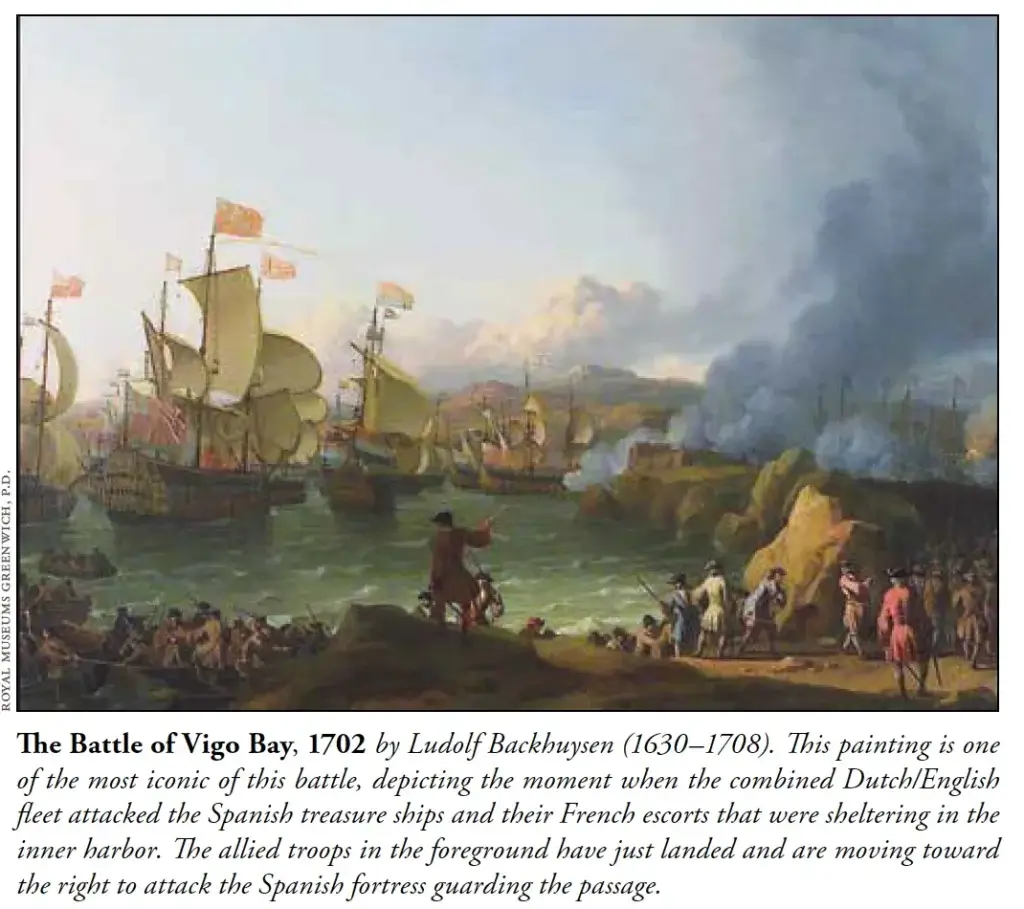
There followed the kind of free-for-all so beloved of Lord Nelson a century later. Hopsonn’s vessel slowly drifted between the Bourbon’s 68 guns and L’Espérance’s 70 guns, cannon belching iron at point-blank range, smashing bulwarks and clipping rigging. A French fireship loaded with snuff got alongside the Torbay and ignited her sails and side. Then, to everyone’s surprise, the fireship exploded, which according to one eyewitness “scatter’d the snuff all over the Torbay and put out the greatest part of the fire.” Terrified, 53 British sailors leapt overboard and drowned. The rest labored to secure their ship, and Rooke praised their “good management” in putting out the remaining flames.
Determined to join the fray, several Dutch captains launched their small boats, and their crews set to hacking at the boom with boarding hatchets. As their ships crossed into the bay, Château-Renault could see the cause was lost and ordered his remaining vessels set afire and abandoned. What had been noisy confusion became a hellscape, as burning ships drifted into one another and sank, while vessels desperately maneuvered around each other to avoid destruction. A British naval officer later wrote, “A singular spectacle was then presented to the Spanish inhabitants, who were gathered on the heights around the bay; the Spanish and French seamen and soldiers endeavouring to destroy their own ships, and the English and Dutch to save them, and both sides intent upon their work alone, and not to annoy each other, except when their mutual interruptions forced them to encounter.” Ormond considered it “a dismal aspect.”
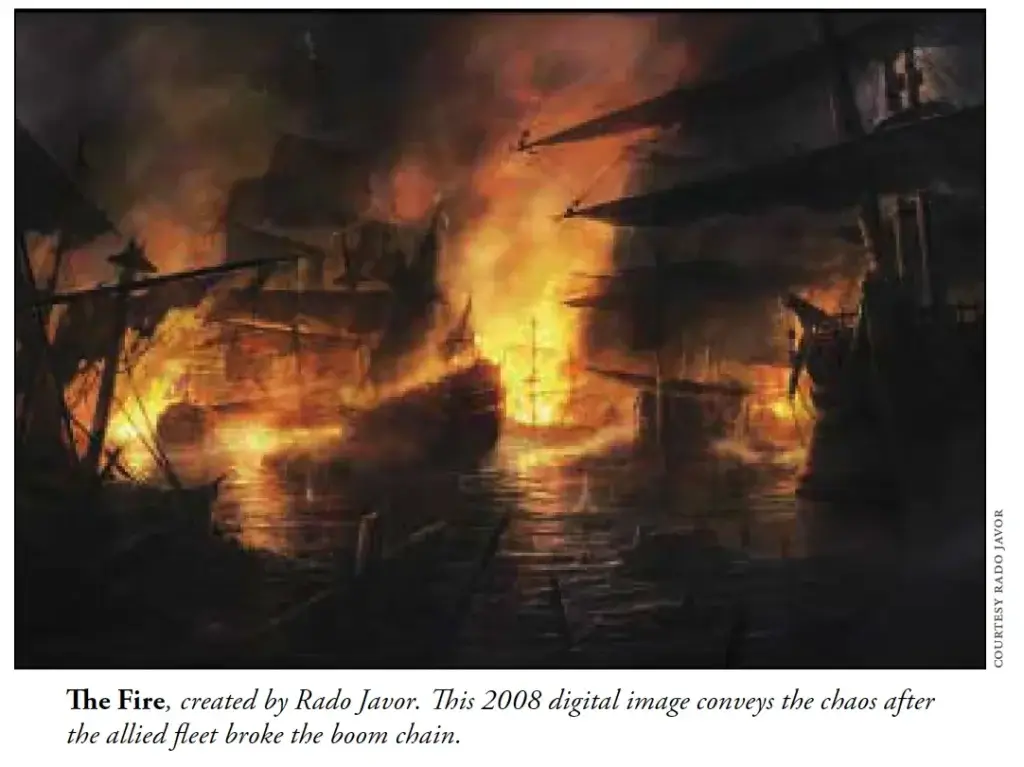
Within hours it was over. That eve-ning, Rooke toured the harbor and tallied the enemy losses, among them Le Fort and its 76 guns “burnt;” L’Espérance “taken, but run ashore and bilged;” Le Solide of 56 guns “burnt;” and Le Triton, 42 guns, “taken afloat and in good condition, to be carried home.” The victory was total, every French and Spanish ship burned, sunk, or captured, with only minor damage to the Alliance, mostly on the Torbay—one witness said her foreyard was “burnt to a Cole” and that some of her gunports were “blewed off.” Casualty estimates vary, but range from highs of 2,000 for the Franco-Spanish and 800 for the allies, to, far more plausibly, 200 for the Franco-Spanish and 100 for the allies. The Battle of Vigo Bay probably looked and sounded much worse than it was with regard to loss of life.
Almost as soon as the last guns sounded, salvage efforts began. Allied sailors secured their prizes and readied them for sea. A dozen French and Spanish ships survived the conflagration, but the British lost the galleon Santo Cristo de Maracaibo when she ran on a rock at the bay’s entrance and sank. Besides working to save these ships, the allies retrieved cannon, shot, anchors, and other usable materials from the wrecks. Since many had settled in shallow water, portions of the rig and super-structure remained above the water and early salvage efforts required little in the way of special equipment.
Rooke knew that most of the silver had already been unloaded and said so at the time. Unfortunately for the allies, much else of what the galleons carried was destroyed or ruined by fire and salt water—the cotton, indigo, sugar, tobacco, and so on. Ironically, these perishables belonged to private British and Dutch merchants, who were eagerly awaiting their delivery to Amsterdam. Even though most of the silver was safely in Spanish hands, the allies managed to collect two tons and forward them to the London Mint. This was enough to cast commemorative Vigo coins. By contrast, Philip got 377 tons, the greatest windfall of any Spanish sovereign from a treasure fleet. Despite these well-known facts, hopeful treasure hunters mounted numerous expeditions across the centuries, which Verne’s book only served to encourage. Few of them recovered anything other than rusted cannon, barnacle-encrusted bottles, jugs, or iron pulleys presumably used for loading and unloading cargo. In recent years, the site is looked at less by looters and more by archaeologists armed with side-scan sonar (and government permits), surveying the bottom of Vigo Bay looking for further remains of these vessels.
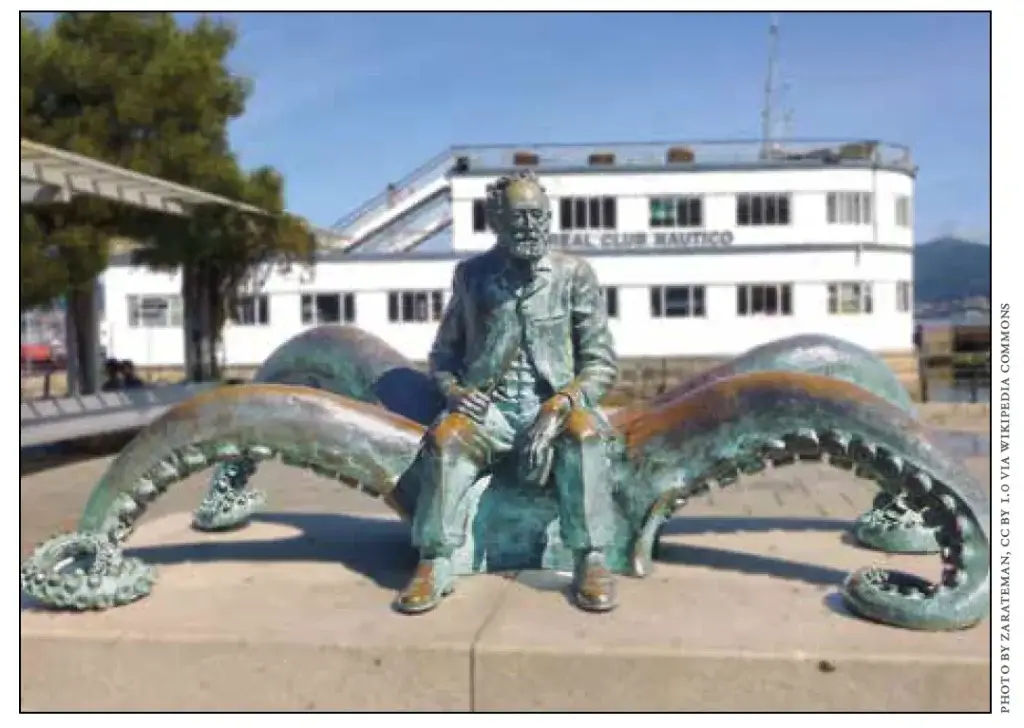
Overall, the allies considered the Battle of Vigo Bay a success, even if it did not produce fabulous riches. It soothed the sting of the Cádiz failure and persuaded the Portuguese king to provide access to Lisbon—a decided advantage. Rooke returned home a hero and would later help capture Gibraltar for the Anglo-Dutch alliance in 1704. Rooke retired from the navy the following year due to poor health. He died in 1709. Thomas Hopsonn received a knighthood from Queen Anne for his actions in the battle and soon afterwards retired from the navy. On the other side, the French suffered greater losses than the Spanish. Louis XIV keenly felt the destruction of so many ships of the line, whereas, fortunately for Philip, all but three of the galleons lost by Spain were private merchant vessels. Despite the catastrophe, Louis ab-solved Château-Renault of any blame. The admiral became a marshal of France the following year and died in 1716. Manuel de Velasco was later a governor in Spanish America, but scandal dogged his administration, and he was recalled. And what of the visionary author who made Vigo Bay so famous? A handsome bronze statue next to the city’s Montero Rios Gardens honors his memory. Created by local artist José Morales and installed in 2005, it depicts Verne seated on the curling tentacles of a giant squid, a fitting tribute to the man whose visionary novels still fire the imagination.
John S. Sledge is the senior architectural his-torian for the Mobile Historic Development Commission and a member of the National Book Critics Circle. He holds a bachelor’s degree in history and Spanish from Auburn University and a master’s in historic preservation from Middle Tennessee State University. Sledge is the author of seven books, including Southern Bound: A Gulf Coast Journalist on Books, Writers, and Literary Journeys of the Heart; The Mobile River; and The Gulf of Mexico: A Maritime History. He has been fascinated by the Battle of Vigo Bay since reading Twenty Thousand Leagues Under the Sea in childhood, and visiting Vigo, Spain, as a college student.